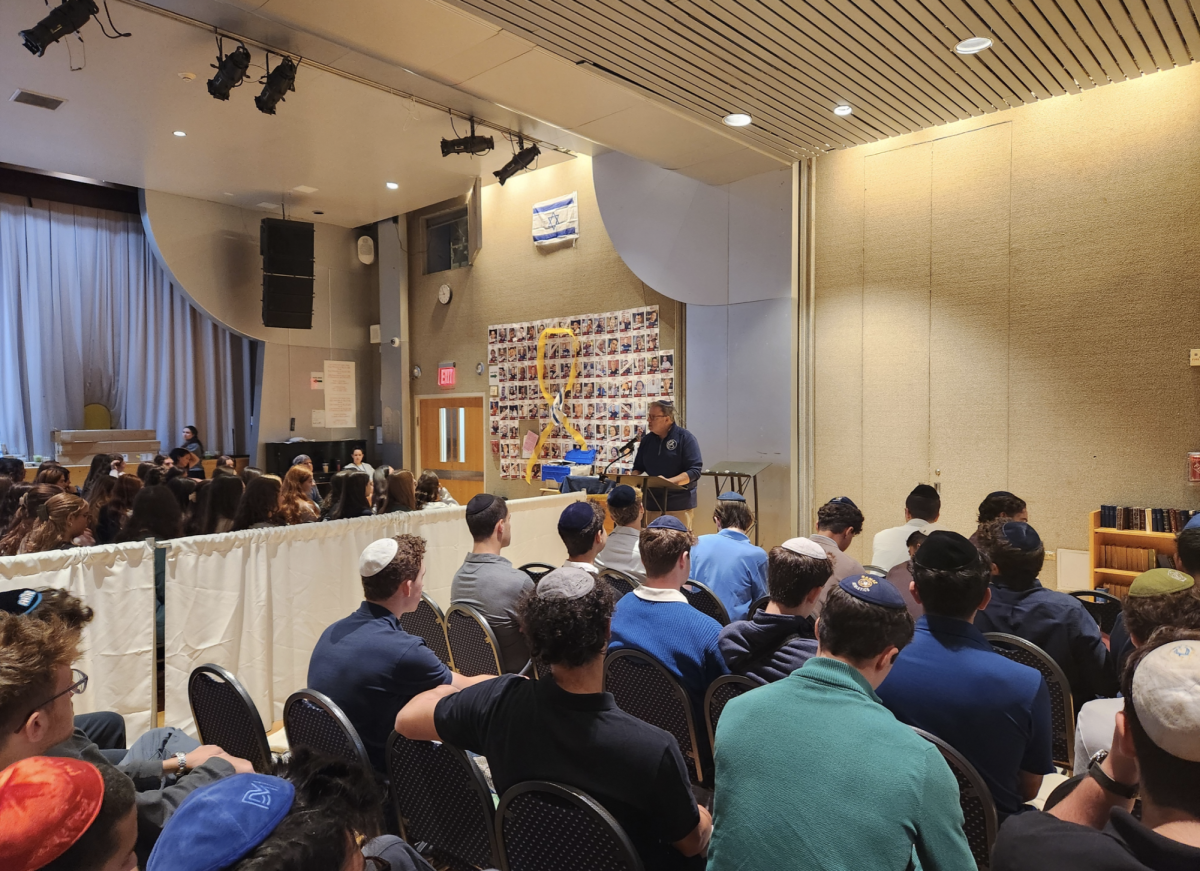
As the third period bell rang, the freshman class piled into the library to hear Nova Festival survivor Eitan Halley speak about his experience on and post October 7th. It was January 9th, and the Class of 2028 had just completed a test. Although it was just a simple, ordinary, routine Thursday, the speaker was anything but ordinary.
Eitan Halley was born in Burlington, Vermont, and moved to Karnei Shomron, Israel with his family when he was seven years old. Before October 7, he was just a normal college student who was pursuing his bachelor’s degree in industrial engineering, enjoyed being in the presence of his friends, and worked hard to pass his test. Since October 7, all that has changed.
Halley attended the festival with ten of his friends. When the rockets started, he and three of his friends went into his car. They started driving towards the entrance they used to enter the festival. That is, until a man yelled at them and told them that there was another entrance. Another way out of there alive. The sound of rockets persisted as they drove on for a good couple of minutes. They pulled over when they saw a roadside shelter. The shelter was already crowded and they had to squeeze in. After them, three more people piled into the shelter and told them that they had run from terrorists shooting at their car. That meant that the terrorists were near and would attack the shelter in a matter of minutes or even seconds. Halley recalls the urgency of the moment in the shelter. A few seconds later, cars pulled up to the shelter’s entrance, and everybody started screaming. As the terrorists started firing at the entrance, people frantically screamed and called for help. People tried calling the police and the army, but no one came. His phone was suddenly blasted out of his hand because a grenade was thrown at the entrance of the shelter. Aner Shapira picked up grenades from the floor and threw them back through the entrance. Aner threw seven grenades, and was killed by the eighth grenade. Halley remembers flying to the wall because of the eighth grenade. Someone flew on top of him, too, because of the explosion. When he got up, he saw that this grenade had killed Aner Shapira, and had left Hersch Goldberg-Polin, who was in this shelter, with half of his hand blown off. The terrorists threw more grenades, and Eitan Halley made it his job to throw them back. When they threw too at once though, he was knocked unconscious from the explosion. When he regained consciousness, he woke up to see a man in a mask, carrying an AK-47, wearing a bandana with the symbol of Hamas on it. That was when the terrorists started taking hostages. They took five hostages in total from Halley’s shelter. When Halley woke up, the terrorists were gone, but so were the five hostages they had taken, and the lives of 17 people. The shelter had started with 29 people, and had ended with seven.
Now, Eitan Halley has transformed his grief and sorrow into informing others about what happened. He organized his own speaking tour to accomplish that goal. First, he flew out to New York and Los Angeles for the screening of the documentary, “We Will Dance Again.” After partaking in the making of this historic documentary, he realized that just working on software engineering wasn’t enough. He got to speak at a fundraiser event in Canada organized by Ben Gurion University. Halley’s friend found him seven lectures to speak at. Another friend found him a lecture at Young Israel of New Rochelle and in the community center of Deal, New Jersey. He also spoke at Joseph Kushner Hebrew Academy. Each event led to another. And that was how he organized his own speaking tour. He also mentioned that he will probably organize another speaking tour that will last a month when he comes back to America. He will try to speak to as many high schools, community centers, Christian schools, and Christian churches. He commented,“You guys [Jewish children] are getting this kind of education at home and at school. Christians, on the other hand, that’s a totally different world. It’s something that they may have never heard of, never open to. This is like educating them from zero, and it’s a lot of responsibility, but it’s incredibly important.”