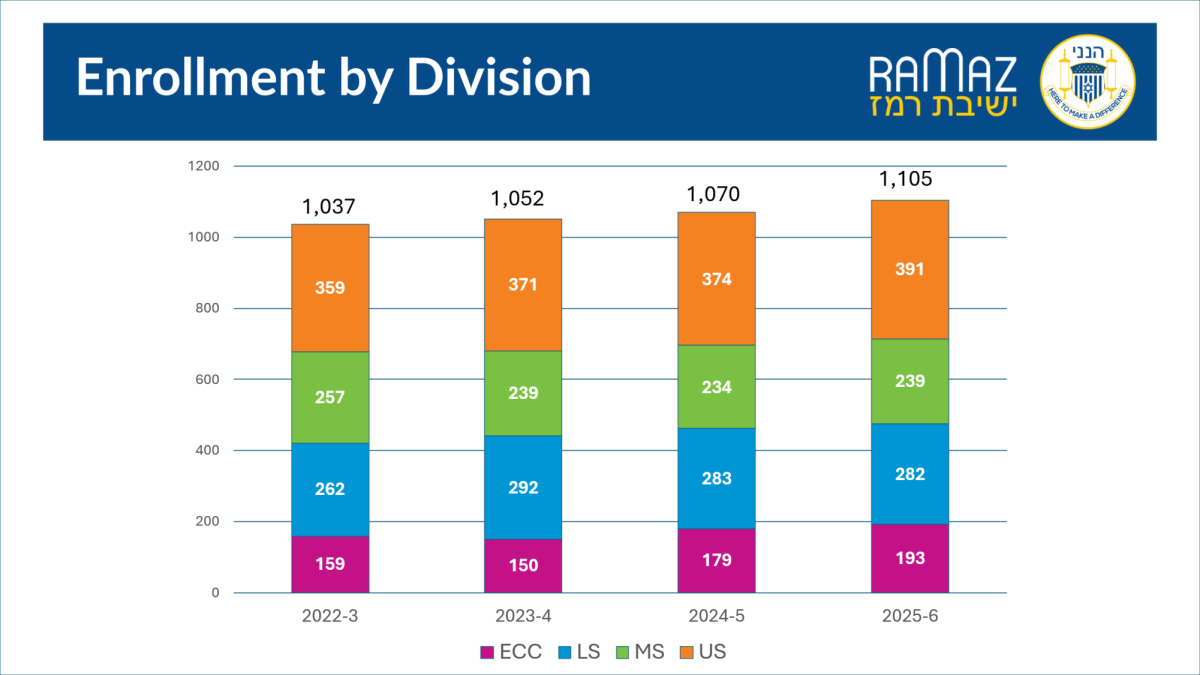
Given its location in New York City, space for the Ramaz Upper School has always been limited. Since the end of Covid 19, overall enrollment has gone up 6.6%, a trend which the administration describes as unsurprising. “So it’s not a spike… it’s a steady pattern and relatively predictable,” said Dr. Wasserman. With the recent growth in enrollment, the amount of space in the facilities has been put under pressure.
For students and teachers, this pressure is felt daily. “It’s hard to get to class on time because of how crowded the staircases and hallways are,” said Maia Bernstein ’27. But hallways are not the only place that feels packed. “Sometimes classrooms don’t even have enough chairs for all the students, if classes begin to get too big, and… It’s just very crowded,” said Ava Hutman ’27.
According to Mr. Blumenthal, who is responsible for organizing student schedules, the current number of students is not unprecedented. “When I started here in 2007, we had 120 students [per grade], so 100 students per grade is not unusual,” he said. However, what has changed over the years is the number of specialized classes. “We have added programming. It used to be standard to have six Talmud tracts, but we recently added Mehina (a class for students without any Talmud background to teach them the basics), and we also have Matmidim, which I think is amazing,” he said. “Something that Ramaz does great is trying to serve everyone and meet their needs, which needs more classrooms in many cases,” he added.
These changes, while aimed to meet student needs, have added challenges to space usage. In total, there are 27 classrooms, including special classrooms like the art room, music room, and labs. This averages about 7 classrooms per grade at a time.
Mr Blumenthal describes why some classes may feel overcrowded. “We have some smaller classes like language classes, which push some other classes to be bigger that meet at the same time.” Despite this situation, “We’re doing our best. For example, we built a new classroom, 402, in the library this year” he said.
However, with these new changes challenges arise. Rabbi Ovadia describes his experience with the new classrooms. “Classes are meeting in places that are not very complete and conducive to learning. Sometimes the space is too big. The desks are too high. There are distractions, like the cables and other things”, he explained. Furthermore, the transformation of a teacher’s office in the library to the new classroom 402 has been “rough for the teachers,” Rabbi Ovadia said. He explained that collaboration can be difficult for teachers as the “Judaic studies department is spread across like 5 locations.”
Between classes, hallways and staircases fill up quickly as students rush to their next class. The third floor is a bottleneck. “Sometimes there is a lot going on the third floor, and it can be hard to get through all the people and get to class,” said Hannah Katz ‘27. Mr. Blumenthal explained the situation, noting that “The 3rd floor is difficult because there are 7 classrooms.” Another student pointed out the congestion in the staircases, “Sometimes if you’re trying to get into the staircase, it’s too full to open the door,” Ava Hutman ‘27.
“It’s a puzzle,” said Mr. Blumenthal, describing the complexity of balancing schedules and classroom space. “I would love to have a new building. I would love to have wider hallways. I would love to have more classrooms. I think that would make a lot of the scheduling easier,” he said. However, he noted that there is “not an immediate solution.” For now, he said, “We may need to adjust our expectations of what a typical class size looks like,” adding that “classes of 20 students are not the end of the world.”
Right now, the school is also beginning to confront larger questions about its future growth. “We’re going to be hitting [capacity] soon if we keep doing even a little bit of the steady growth,” said Head of School Dr. Wasserman. He shared that the school is currently grappling with key questions including, “Do we want to grow? Do we want to stay the same size?” He added that if the school chooses to grow, it would require major changes to facilities. The outcome could reshape not just the campus, but the daily experience inside it.